Midwest Maintenance Facility

Amtrak and Canal Edge are building a modern maintenance facility to support passenger rail in Chicago and across the Midwest.

Project Links

Project Documents

Project Plans and Reference Documents
01 Construction Site Plans 02 Trainshed Renderings
03 NEPA Approval & Environmental Studies - Coming
04 Environmental Review Summary 05 August 2026 Community Presentation 06 August 2026 Community Presentation (Spanish) 07 August 2026 Community Presentation (Mandarin) 08 September 2026 Community Presentation 09 September 2026 Community Presentation (Spanish) 10 September 2026 Community Presentation (Mandarin) 11 FAQ Supplemental Information
Community & Labor Support
01 International Union of Operating Engineers Letter of Support - Including the 28 IUOE Local 150 members who live in the 11th Ward 02 Chicago Federation of Labor and Transportation Trades Department Letter of Support - Including the 500,000 Chicago and Cook County Workers They Represent 03 Chicago Federation of Labor Letter to City Council (October 6, 2026) 04 Rail Labor Groups Support Amtrak’s New Midwest Maintenance Facility at the Canal Street Yard in Chicago
05 Other letters awaiting formal approval for public posting

Project Overview

Midwest Maintenance Facility Overview

Chicago is the hub of Amtrak's national network. More than half of Amtrak's long-distance trains begin or end their trips here, and 16 Amtrak routes depend on Chicago-based maintenance capacity. As rail equipment, service demands, and federal safety and operating standards have evolved, Amtrak's existing maintenance facility no longer provides the space, configuration, or modern capabilities needed to efficiently support today's fleet and anticipated future growth.

Amtrak identified the need for a new facility years ago, evaluated alternatives, and selected Canal Street Yard as the site for a new, purpose-built Midwest Maintenance Facility. Amtrak then advanced the project through federal environmental review and the federal grant process. Canal Edge joined later as the private development and delivery partner. Amtrak will wholly own the completed facility.

The new facility is designed first around safety — moving service and inspection work indoors into a modern configuration built for today's equipment and practices while improving equipment reliability, operational efficiency, and long-term passenger-rail capacity throughout the Midwest.

In August 2026, the Federal Railroad Administration (FRA) awarded Amtrak up to $572 million through the National Railroad Partnership Program for the maintenance modernization project. FRA separately awarded up to $87 million to rehabilitate or replace aging bridges, viaducts, and related structures in the area — work FRA says will address critical structural deficiencies and eliminate hazards affecting rail operations, drivers, and pedestrians. Each award requires a 20 percent non-federal match.

Canal Edge will deliver the approximately $900 million project, complementing the federal investment with substantial private capital. Construction is expected to support thousands of jobs, including union and skilled-labor positions, over approximately 18 months, along with long-term operational employment at the completed facility.
Status

Up to $572M and up to $87M in FRA National Railroad Partnership Program funding awarded to Amtrak for the facility and viaduct repairs.

Funding

U.S. Department of Transportation / Federal Railroad Administration · Amtrak

Questions

For additional information about the project, please contact info@mwmaintenancefacility.com

Events

Outreach sessions will be held throughout the pre-construction and construction phases at locations in the Bridgeport, Armour Square, and Chinatown communities.

Sign up here for project updates.

Sign up for future subcontracting opportunities

Project Overview

Project Timeline

2023 – 2026 · 14 milestones

  1. Chicago rail modernization need identified.

    Amtrak identified Canal Street railyard in State rail planning. The 2023 Illinois State Rail Plan identifies acquisition of the Canal Street railyard as part of continued investment in Chicago-area passenger-rail infrastructure.

  2. Amtrak publicly advances the Chicago Hub Improvement Program.

    During 2024, Amtrak continues publicly presenting the Chicago Hub Improvement Program (CHIP), its broader program to improve passenger-rail infrastructure and operations in the Chicago region, and evaluates how to address the limitations of its 14th Street maintenance facility.

  3. Canal Street Yard publicly identified.

    At a public Midwest passenger-rail presentation, Amtrak states that its 14th Street Yard is capacity constrained and discloses that it has begun discussions with a Class I Freight Rail property owner regarding the potential acquisition of Canal Street Yard, identifying acquisition, design, and initial site work as part of its federal funding strategy.

  4. Public discussion and outside support.

    Public agencies and passenger-rail organizations discuss Amtrak's planned Canal Street acquisition and its role in improving Chicago-area passenger-rail maintenance capacity.

  5. NEPA Categorical Exclusion for the acquisition.

    The Federal Railroad Administration (FRA) determines under the National Environmental Policy Act (NEPA) that Amtrak's proposed Canal Street property acquisition and initial security improvements qualify for a Categorical Exclusion.

  6. Amtrak again presents Canal Street as part of its Chicago strategy.

    At the Midwest Interstate Passenger Rail Commission's Invest Midwest Forum, Amtrak presents the Chicago Hub Improvement Program, including a new Chicago maintenance facility at Canal Street Yard following acquisition from a Class I Freight Rail property owner.

  7. Private-sector delivery support added.

    Canal Edge becomes involved as a private-sector development and delivery partner supporting Amtrak's maintenance-modernization program, helping advance the development of the replacement maintenance infrastructure.

  8. Amtrak Meets with Alderwoman Nicole Lee

    Amtrak meets with Alderwoman Nicole Lee to discuss the project and potential move to the 11th Ward.

  9. Amtrak and Canal Edge meet with Commissioner John Daley and Alderwoman Nicole Lee.

    Amtrak and Canal Edge present the Midwest Maintenance Facility relocation to Canal Street Yards at the Alderwoman’s office and discussed the move to her ward.

  10. Public presentation at UIC.

    Amtrak representatives present the Chicago Hub Improvement Program and associated modernization initiatives publicly at the University of Illinois Chicago.

  11. FRA issues NEPA Categorical Exclusion for the facility.

    The Federal Railroad Administration issues a Categorical Exclusion determination under NEPA for the maintenance modernization project. Section 106 consultation concluded with a finding of no adverse effect on historic properties, with concurrence from the Illinois State Historic Preservation Office.

  12. FRA awards up to $572 million for maintenance modernization.

    The FRA awards up to $572 million for the Midwest Maintenance Facility Modernization Project. The federal project description states the investment will improve efficiency and safety at Amtrak’s Chicago-area maintenance facilities by relocating certain maintenance functions from the 14th Street Yard to the Canal Street Yard, improve system performance, and support anticipated passenger rail demand. The award requires a 20 percent non-federal match.

  13. FRA awards up to $87 million for bridge and viaduct repairs near Canal Street Yard.

    The FRA separately awards up to $87 million for the rehabilitation of aging viaducts, bridges, and related structures at Canal Street Yard — work FRA states will address critical structural deficiencies and hazards affecting rail operations, motorists, and pedestrians. This award also requires a 20 percent non-federal match.

  14. Public information and community engagement expand.

    The project website provides information on the project's purpose, federal environmental review, anticipated operations, transportation and access, infrastructure improvements, construction considerations, and answers to community questions. A public community meeting was held on Thursday, September 17, 2026, where project representatives and technical experts presented information and responded to questions. The presentation and meeting video are posted on this website.

    Current

Project Information

Frequently Asked Questions

68 questions

The Project at a Glance 7 questions
01 What is Amtrak building at Canal Street?

Amtrak is moving its Chicago maintenance and inspection operations from the 14th Street Coach Yard to the Canal Street Yard at 436 West 25th Place.

The new facility will provide indoor inspection and maintenance, train servicing and storage, and the supporting functions that keep passenger trains running. It will also include a maintenance and inspection building with indoor service tracks, a car wash, a wheel truing facility, reconfigured yard tracks, and employee and utility support space.

This will be a passenger equipment facility. It is not a freight yard, and it does not sort or drop freight cars or lift and drop thousands of shipping containers 24/7.

The Canal Street Yard has operated as a rail yard for more than a century, and it stays one. Amtrak is not converting the property to a different kind of use and is not expanding the yard footprint. The work happens inside the existing yard, on land that is already railroad land. What changes is the kind of railroad work done there — passenger train maintenance in place of the freight container handling the yard was built up for.

02 Where exactly is the project?

436 West 25th Place. The Canal Street Yard runs along an elevated rail corridor from just north of Cermak Road south to West 38th Street, between South Canal Street and South Stewart Avenue. The facility will remain inside that yard and will not extend beyond its boundary. No home, business, park, or public street is being acquired. Amtrak also plans an offsite commissary near the yard, which supplies food and provisions for Amtrak trains; the specific location is being finalized.

03 How big is the facility?

The yard covers approximately 57 acres across multiple city blocks on a rail corridor raised about nineteen feet above the adjacent streets, and it will not get any larger. The maintenance and inspection building will be the largest new structure with a footprint of approximately 138,600 square feet and total area of 167,000 square feet. The facility will be comprised of ground level maintenance space with five indoor service tracks and approximately 30,500 square feet of Amtrak office and staff space. The indoor service tracks will be sized so a full trainset can be brought inside rather than worked on outside in the open. Everything will be built within the existing yard footprint on an elevated property that already carries rail operations. Dimensions and site layout are in the project documents.

04 Why does Amtrak need this project?

Chicago supports 16 Amtrak routes, and more than half of Amtrak’s long-distance trains begin or end here. Amtrak’s current yard at 14th Street is undersized and fragmented. Crews split trainsets and shuttle equipment between buildings, much of the work happens outdoors throughout Chicago winters, and the site cannot accommodate today’s equipment.

05 Why Canal Street?

A maintenance yard needs direct rail connectivity, acreage, the right track geometry, and access to Union Station. The Canal Street Yard has hosted railroad operations for more than a century and meets those requirements, and building there allows Amtrak to keep running service throughout construction instead of working around active trains for years.

06 What was this property before?

The Canal Street property has been active rail land for more than a century. The yard began as team tracks for the Chicago and Western Indiana railroads and ran as a Class I freight railroad's intermodal container terminal from the 1980s, later serving as a container depot, until 2019. Gantry cranes lifted and dropped shipping containers on and off railcars, and the operation ran around the clock. At its peak in the mid-2000s it handled more than 150,000 container lifts and drops a year.

Volume fell away after the railroad opened larger terminals elsewhere in the region. The property has been used for other railroad-related purposes since it stopped handling containers in 2019. The freight-era comparison in these FAQs is a comparison with how the site ran for decades, not with how it has run in the last few years.

07 What changes in the type of rail work that happens here?

Under its previous freight railroad owner, the yard was a freight facility which ran around the clock moving and coupling railcars, handling containers, and operating switch engines.

Amtrak’s use will be much less intensive. Trains arrive, are serviced largely indoors, and are stored until they return to service. There is no freight sorting, no container handling, and no continuous switching. Most activity follows Amtrak’s daytime arrival and departure schedule, with a smaller number of movements in the evening and overnight.

What It Means for Neighbors 15 questions
08 Will this facility operate 24-hours a day?

For decades, the Canal Street Yard ran around the clock as a freight facility. Its container operation, with cranes lifting and setting down heavy containers day and night, was a significant source of noise and vibration.

Amtrak’s use of the yard is primarily a daytime operation, with limited overnight work. Train movements, heavier maintenance, wheel truing, the car wash, and deliveries are concentrated in daytime and early evening hours.

Overnight, a limited crew prepares trains for the next morning’s departures, and most of what happens is indoor work on a train that is standing still: cleaning interiors, servicing restrooms, taking on water, and restocking for the next day, with inspection and light repair inside the building. Equipment is plugged into wayside power with engines shut down. What remains outdoors is slow movement between the storage tracks and the building, and the occasional late arrival.

09 What will residents hear — and how loud will it be at the closest homes?

Maintenance and inspection work happens inside an enclosed train shed. What remains outdoors is low-speed train movement, coupling, the car wash, and building ventilation. Amtrak trains are lighter, shorter, and quieter than the freight trains handled here previously, and stationary equipment is plugged into on-site power rather than idling.

The noise and vibration assessment measured existing conditions at eight locations and modeled projected noise at residential locations on both sides of the yard, using federal methodology. It found no severe noise impacts and no vibration impacts anywhere in the study area. At some locations closest to the tracks, projected levels fall in what federal criteria call the moderate range — a measurable change from the current condition, below the level treated as significant, and identified location by location in the assessment.

10 How close is this facility to homes?

The nearest residential structures to the new enclosed facility are located at W 33rd St and S Canal Street – approximately 120 feet corner point to corner point. The yard has run immediately alongside these blocks for its entire history, and in some locations, homes sit directly across the street from the rail embankment. Distances from the yard tracks to the nearest homes are set out location by location in the noise and vibration assessment.

The site plan takes this into account. The taller maintenance building sits toward the interior of the yard rather than at the street edge, and the car wash structure is low, located near the I-90/94 Dan Ryan Expressway bridge, and set back from the street edge. Design development is continuing, and Amtrak will share renderings as the design advances.

11 Will locomotives idle overnight?

Outdoor idling is minimal. The facility is designed with wayside power so equipment can be plugged in rather than left running, which conserves fuel and reduces noise. Locomotives assigned to Amtrak’s Midwest services also meet EPA Tier 4, the most stringent federal emissions standard for locomotives.

12 What about lighting at night?

Property lighting uses modern shielded LED fixtures set at lower heights, which cut spill and glare. They replace the legacy high-mast unshielded fixtures used in the yard’s freight era.

13 What about air quality and emissions impacts?

Locomotives assigned to Midwest services and Amtrak’s newer long-distance locomotives meet EPA Tier 4 standards, railcar maintenance is performed indoors, and stationary equipment is plugged in rather than left idling. The project screened below federal Clean Air Act conformity thresholds.

Construction may temporarily generate dust and equipment emissions, which will be managed through standard practices such as dust suppression, covered loads, and street cleaning.

Set against the freight era, when the yard ran multiple diesel switching units daily, emissions at the site are substantially lower. Set against the last few years, there is more activity than there has recently been — but it is passenger equipment meeting current federal emissions standards, plugged in rather than left idling, with maintenance work done indoors.

14 How much traffic will there be from employees, trucks, and services vehicles?

The traffic analysis evaluated the project against the federal significance criteria across regional and local roadway operations, CTA bus and rail service, and roadway safety, and found no significant adverse impacts and no mitigation required. The project changes no roadway geometry, capacity, or curb space on public streets.

Employee and contractor parking is accommodated on site within the yard’s existing allocations. The project creates no permanent off-site parking need and no expected spillover onto residential streets.

15 How do vehicles get in and out of the yard?

Through the existing ramps. The ramps currently serving the yard at 25th Place, 29th Street, and between 33rd and 35th Street will be rehabilitated, and the 23rd Street ramp stays closed. The project does not create new access points, curb cuts, or driveways on public streets.

Construction will generate temporary truck activity, which will be managed through designated routes and scheduled outside peak hours.

16 Will anyone lose a home or business? Eminent domain?

No, to both. This is one railroad buying an existing rail yard from another, and the purchase covers the yard itself. No property is being acquired except for the Canal Street Yard. No resident, business, park land, or public street is being permanently displaced by this project. Amtrak also plans an offsite commissary near the yard, which supplies food and provisions for Amtrak trains; the specific location is being finalized.

17 Will the facility grow and add more trains later?

The facility is sized for Amtrak’s current Chicago operations plus the service growth Illinois and neighboring states have already planned publicly. A material expansion beyond that would require additional planning, funding, and any applicable environmental and regulatory review.

18 What are the health effects for people living near the facility?

The environmental review examined air quality, noise and vibration, traffic, and site conditions, each under federal methods. The air quality analysis screened below the federal Clean Air Act conformity thresholds. The noise and vibration assessment, prepared by WSP, found no severe noise impacts and no vibration impacts anywhere in the study area, with projected levels at some of the closest locations falling in what federal criteria call the moderate range.

The facility is also designed to reduce what reaches the neighborhood compared with how this yard operated for decades. Maintenance is performed indoors, stationary equipment is plugged into wayside power rather than left idling, and locomotives assigned to Amtrak’s Midwest services and Amtrak’s newer long-distance locomotives meet EPA Tier 4, the most stringent federal emissions standard for locomotives. Set against the freight era, when the yard handled containers around the clock and ran multiple diesel switching units daily, emissions at the site are substantially lower.

Construction may require groundwater removal during excavation. Groundwater encountered during excavation will be contained and held pending analytical review. There will be no untreated discharge to storm or sanitary sewer systems, and PFAS-impacted water will be routed to a permitted treatment or disposal facility.

The Environmental Review Summary is available on the website, and the determination and completed studies will be posted on the website.

19 Will air quality be monitored, and are public health agencies involved?

The air quality analysis prepared for the environmental review screened below the federal Clean Air Act conformity thresholds, and the Environmental Review Summary is available on the website. The determination and completed studies will be posted on the website.

During construction, dust will be controlled through water application, covered stockpiles and covered haul trucks, with field inspections during earthwork, and the contractor’s site safety plan includes air monitoring as needed to protect workers. This is all detailed in a Soil Management Plan that is prepared for the construction activities at the site.

20 What about the schools near the yard?

The noise and vibration assessment modeled projected levels at locations on both sides of the yard and found no severe noise impacts and no vibration impacts in the study area defined by federal methods. All schools are farther from the yard than the locations used to assess noise and vibration. Maintenance work is performed indoors, stationary equipment is plugged into wayside power rather than left idling, and locomotives assigned to Amtrak’s Midwest services meet EPA Tier 4 standards.

21 Will noise barriers be installed at the locations the study identified as moderate impacts?

The noise and vibration assessment found no severe noise impacts and no vibration impacts anywhere in the study area. At some locations closest to the tracks, projected levels fall in what federal criteria call the moderate range, and the assessment identifies those locations individually.

The assessment also evaluated measures that would reduce levels at those locations, including a noise barrier along the western boundary of the yard at a few localized areas and different track switches where wheels would otherwise pass over open gaps.

Amtrak will evaluate these measures during final design and share the results with the community before the affected track segments are built.

22 Could vibration from the yard damage nearby homes?

The noise and vibration assessment modeled projected vibration using federal methodology. It found no vibration impacts anywhere in the study area. Yard movements are made at low speeds of 5 to 15 miles per hour, and projected vibration levels are well below both the federal criteria for homes and the much higher levels associated with damage to buildings. The assessment also found that construction activity would not reach levels associated with building damage.

Trains and Daily Operations 10 questions
23 How many trains enter and leave each day?

The facility will service trains from Chicago’s 16 Amtrak routes: 8 long-distance and 8 state-supported. Each of those trains will enter and exit the yard for critical inspections, continuous maintenance, cleaning, refueling, provisioning and preparation to safely depart Chicago at their scheduled times. Trains arrive for servicing mostly in the mid and late morning and move back out largely in the afternoon and early evening, supporting scheduled departures from Union Station. This is equipment already operating in and out of Chicago today; the project changes where it is serviced rather than how much of it there is. Movements within the yard are made at low speeds of 5-15 miles per hour, and the daily movement counts used in the environmental analysis are set out in the noise and vibration assessment.

24 What maintenance will take place at Canal Street?

Maintenance at Canal Street focuses on light- to medium-level work that can be completed in short daily work windows, such as inspections, brake tests, fueling, cleaning, and minor repairs. Depending on the train, servicing includes exterior washing, interior cleaning and restocking, fueling, and scheduled inspection and maintenance. Long-distance trains get the most work; some state-supported corridor trains need only cleaning or fueling. Heavy maintenance that takes a locomotive or coach out of service for days will be done at Amtrak’s heavy repair locomotive shop in the existing yard near 16th Street, at Amtrak’s Brighton Park facility in Chicago, or at Amtrak’s shops in Beech Grove, Indiana.

Each day, a train’s visit follows the same sequence: daily maintenance, refueling, cleaning inside and out, restocking the café car and restrooms, and finally pre-departure safety checks. The whole visit takes a few hours, depending on the type of train and the condition it arrives in. Once trains are ready, they return to Union Station for passenger boarding and departure.

25 How will trains travel between Union Station and the yard?

Amtrak’s plan is for trains serving each of Chicago’s 16 routes to visit the maintenance facility at least once a day, with trainsets stored there overnight. After passengers leave the train at Union Station, it travels to the yard over the South Branch Bridge; trains that need to be turned around use the wye on the way. The route runs primarily on track that Amtrak owns or dispatches and connects directly to the yard without using other freight railroads’ track. It passes over the Canadian National tracks at 21st Street.

26 Will the project tie up the South Branch Bridge?

No. Train time on the South Branch Bridge will be consistent with what it is today. What matters most at the South Branch Bridge is how long Amtrak trains occupy it. The bridge is a lift bridge more than a century old, and while a train is on it, the Canadian National freight rail interchange is blocked. Total daily bridge occupancy by Amtrak trains is expected to stay about the same as it is today.

Today, the entry to the 14th Street Yard is at its southern end, next to the lift bridge at Lumber Street. Every train entering has to pull its full length past the entry point, stop, and reverse into the yard, which puts it over part or all of the bridge. Stopping and changing direction on an aging lift bridge takes time and blocks the freight interchange while it happens. Trains going to Canal Street will cross the bridge more often than trains do today, but they will not stop on it. They will cross at a steady speed, which keeps total occupancy time about the same.

27 Will Amtrak’s trains delay Metra?

No, the operating plan was built around existing scheduled Metra and Amtrak trains at the South Branch Bridge, with each Canal Street Yard movement placed in a gap between them to generate no new scheduled conflicts. In the case of off-schedule operations, yard movements are managed with the objective of avoiding delays to Metra passenger service. Amtrak and the project team continue to work with Metra to ensure smooth and resilient operations in the Chicago Union Station area.

28 Does Amtrak have agreements with the other railroads it shares track with?

Yes. Amtrak maintains operating agreements with the freight railroads whose track it uses, and with Metra, which uses Amtrak-owned track and Chicago Union Station, which Amtrak also owns. Federal law also gives passenger trains preference over freight trains on shared rail lines, junctions, and crossings.

29 Is this a safety project?

Safety is a core reason the project exists. Modern track spacing and straight-track servicing mean better sightlines and fewer conflicting movements, and work currently done outdoors moves inside. The yard becomes fenced, camera-monitored, and access-controlled with regular patrols, replacing an open yard with limited security.

30 What is the capacity of the current facility compared with the Canal Street facility?

The 14th Street Yard is undersized and fragmented for the fleet it serves. Crews split trainsets and shuttle equipment between buildings, much of the work happens outdoors through Chicago winters, and the site cannot accommodate today’s equipment. The new facility brings inspection and maintenance indoors with five service tracks sized so full trainsets can be worked on inside rather than in the open.

The facility is sized for Amtrak’s current Chicago operations plus the service growth Illinois and neighboring states have already planned publicly.

31 Could freight operations return to this yard?

Amtrak is acquiring the yard for passenger equipment maintenance and will own and operate the completed facility. The work performed there is inspection, servicing, cleaning, fueling and storage of Amtrak trains. There is no freight sorting, no container handling and no continuous switching.

32 Could a Metra station at 35th Street be accommodated?

A new Metra station would be a decision for Metra and the City rather than for Amtrak or this project. While there is some Metra service that passes next to the yard, there is an existing Metra station with much more frequent service at 35th Street.

Amtrak and the project team continue to coordinate with Metra on operations in the Chicago Union Station area.

Canal Edge and 14th Street 3 questions
33 Did Canal Edge LLC or the White Sox cause Amtrak to move?

No. By November 2024, Amtrak had publicly described 14th Street as capacity constrained and disclosed discussions with a Class I freight railroad regarding Canal Street. Federal environmental review of the acquisition followed in 2025. In the fall of 2025, following Amtrak's solicitation for the 14th Street property, Canal Edge LLC submitted a proposal and was later selected to become the private development and delivery partner, helping make Amtrak's project executable. Canal Edge has since announced a separate development concept for the 14th Street site. That project would need its own approvals and its own public process.

34 Why is Canal Edge LLC involved?

Canal Edge LLC is the private development and delivery partner for the project, responsible for constructing and delivering the project to Amtrak. This public-private partnership model facilitates construction and supplies the private capital the project requires alongside the federal grants. The completed facility will be owned and operated by Amtrak.

35 What happens to the 14th Street site?

Amtrak will not vacate the property until the new replacement facility is constructed and operational. Any redevelopment for non-rail use would be by others as a separate project with its own public processes.

Alternatives 5 questions
36 Why not just rebuild 14th Street?

Rebuilding in place would mean years of construction around an active rail yard and live passenger operations, ending inside the same constrained footprint the project is meant to solve.

37 Why not build somewhere else?

A maintenance yard needs rail connectivity, acreage, track geometry, and access to Union Station without repositioning moves that degrade service. Amtrak looked at Global 1 at 1535 S. Western Avenue, which had problems with property availability, dispatching, routing, and constructability. Canal Street fit Amtrak’s operating and site needs better.

38 What were the real alternatives?

Amtrak evaluated three sites before 2023: rebuilding the 14th Street Yard in place, Global 1, and Canal Street. All three were near Union Station, with proximity to Amtrak routes and enough acreage. Continuing to patch the existing facility was the fourth option and does not solve the capacity problem.

39 What happens if Canal Street does not proceed?

The maintenance need would remain, and Amtrak would be back to patching an aging facility, rebuilding the 14th Street Yard around active rail operations, or starting the entire relocation process again elsewhere.

Continuing to rely on the 14th Street Yard would mean declining service reliability and, eventually, severe limits on meeting future service needs.

The Canal Street Yard would remain railroad property and future railroad use of the site would be governed by the applicable railroad regulatory framework. It would not become a park or public open space.

40 What happens to Canal Street Yard if Amtrak doesn’t buy it?

It remains railroad property, in railroad use, under whichever railroad owns it.

Environmental Review and Site Conditions 11 questions
41 What environmental review was done, and what did it find?

The Federal Railroad Administration (FRA), as the federal lead agency, approved a Categorical Exclusion (CE) for the project to satisfy NEPA requirements. Amtrak coordinated with the FRA to evaluate all relevant types of environmental impacts including noise and vibration, air quality, traffic, historic resources, site conditions, and public safety. The CE is supported by technical studies — including a noise and vibration assessment prepared by WSP in coordination with the U.S. Department of Transportation's Volpe Center.

The studies found no significant environmental effects under the federal criteria that define significance. FRA issued its determination in May 2026, after coordinating with two other federal transportation agencies, and attached environmental requirements that Amtrak carries out as the work proceeds.

The determination and the studies behind it will be posted, and they carry the measurements and analysis this answer summarizes.

42 What is a Categorical Exclusion?

It is a determination, made on a documented record, that a project of this type in this setting does not have significant environmental effects. Evaluation of potential environmental impacts from the project is required to ensure that a CE is the appropriate approval pathway under NEPA.

The record supported it here because the project meets the regulatory requirements of a CE and would not have significant environmental impacts. The work stays inside an existing rail yard on land already in railroad use, adds no new passenger trains and no public grade crossings, and changes no street geometry.

43 Why wasn’t a more in-depth environmental study done?

An in-depth environmental review was completed in support of the CE. Noise and vibration, air quality, and traffic were each analyzed by technical consultants using the same federal methods applied to projects that go through longer processes, and site conditions were investigated on the ground. Those studies are what the determination rests on, and they will be published.

FRA requires the evaluation of environmental impacts based on the types of work and potential resources and communities that could be impacted. The level of detail and studies to be completed are determined based on the types of work proposed and long-term function of the facility relative to existing conditions. This project will build a maintenance facility inside an existing rail yard, on land already in railroad use, adding no mainline track, no public grade crossings, and no change to street geometry. Had the studies found significant effects, additional in-depth studies and mitigation may have been required, but no such impacts were identified.

44 Why wasn’t there more public consultation before the review concluded?

The review included consultation with several agencies and organizations as required under environmental regulations. In accordance with Section 106 regulations, Amtrak consulted the Illinois State Historic Preservation Office and invited tribes and other consulting parties including the City’s Historic Preservation Division, the 11th Ward Service Office, and Preservation Chicago to comment on the project’s potential effects on historic properties identified within the project’s area of potential effects. Additionally, FRA coordinated with two other federal transportation agencies before issuing its determination.

A NEPA CE does not require a published comment period or public meeting. Those belong to environmental impact statements or environmental assessments, which are used for projects that may have significant effects.

45 Will you release the studies?

Yes. We are working to post the environmental determination, the traffic analysis, the noise and vibration assessment, and the air quality materials at MWMaintenanceFacility.com, so residents can review the same information we are using.

46 Is the site contaminated?

Amtrak performed environmental site assessments as part of the project’s review — standard due diligence for a historic rail and industrial property. Conditions were found that are consistent with that history.

Construction will be done in accordance with environmental requirements and project procedures governing the testing, handling, and disposal of soils and other materials, with oversight and documentation. Where soils are disturbed, they are tested and managed under those requirements rather than left unexamined.

47 What hazardous materials might be used at the Canal Street site?

The facility may use diesel fuel, lubricants, car wash chemicals, and ordinary maintenance products on site. All will be stored and handled under federal safety and environmental requirements with spill containment at fueling locations. The range and volume are narrower than what the site handled in its freight era.

48 What infrastructure gets repaired? Stormwater?

Federal grant funding supports repairs to viaducts showing structural decay, with improved lighting underneath them and better ongoing maintenance. The project also adds engineered stormwater detention and yard drainage the site does not have today.

49 How are fuels, wastewater and spills handled — and how would neighbors be notified?

The facility will use diesel fuel, lubricants, car wash chemicals and ordinary maintenance products. All will be stored and handled under federal safety and environmental requirements, with spill containment at fueling locations. Fueling systems include containment and leak monitoring. Wastewater from the shop and car wash passes through oil-water separators before entering the sewer system, and the car wash recycles its water.

Detailed operational plans — including but not limited to spill prevention and response plan, discharge monitoring procedures, etc. — will be developed by Amtrak as part of facility planning before operations begin, consistent with federal requirements.

50 Who performed the environmental studies?

The noise and vibration assessment was prepared by WSP.

Environmental studies were performed by WSP, Bacon Farmer Workman Engineering & Testing, Inc., and Cultural Resource Analysts, Inc., which prepared the Section 106 historic resources reports submitted to the Illinois State Historic Preservation Office. Canal Edge, the project’s development and delivery partner, retained Bacon Farmer Workman for several of the studies, and Amtrak and the construction contractor provided some of the required information for the studies.

The Federal Railroad Administration, as the federal lead agency, reviewed the studies and issued its determination in May 2026 after coordinating with two other federal transportation agencies.

51 Why weren’t the viaducts repaired before now?

The viaducts, bridges and retaining walls along the yard are railroad structures, and their condition reflects their age. FRA’s award describes critical structural deficiencies and hazards affecting rail operations, motorists and pedestrians at these structures.

The federal grant now makes the repairs possible. Up to $87 million was separately awarded to rehabilitate or replace aging viaducts, bridges and related structures at the Canal Street Yard, with improved lighting underneath them and better ongoing maintenance. That work takes place at street level rather than inside the fenced yard.

Funding, Jobs, and Taxes 6 questions
52 How much federal funding, and for what?

FRA awarded up to $572 million for the facility and up to $87 million to rehabilitate or replace bridges, viaducts, and related structures in the area. The approximately $900 million project is being delivered by Canal Edge LLC, which is providing private capital to support project implementation. The completed facility will be owned and operated by Amtrak.

53 How is the federal funding split between acquisition and construction?

FRA’s published project summaries set out the federal contribution: up to $572 million for the Midwest Maintenance Facility Modernization and up to $87 million to rehabilitate or replace bridges, viaducts, and related structures at the Canal Street Yard. The remainder comes from non-federal matching sources.

54 Can Amtrak just move that money somewhere else?

No. FRA funded modernization and improvements at the Canal Street Yard, not a general Chicago project account. Projects are individually evaluated and selected on a defined scope, a defined environmental review, and a defined match. A materially different project would go through its own federal process.

55 How many jobs will the project support?

Construction is expected to generate approximately 3,000 jobs including union and skilled-trades positions over the course of the 18-month build-out. This is the total job number across the whole build, not the number on site at any one time. Once operating, the facility is expected to support roughly 400 permanent jobs relocating from 14th Street.

Amtrak intends to prioritize local hiring and hold hiring fairs closer to construction, and is open to working with local workforce development partners.

56 Does the City lose property taxes when tax-exempt Amtrak replaces a freight railroad?

Amtrak is federally chartered and is exempt from state and local taxes, including property taxes. But the change here is likely smaller than the question assumes, because of how railroad property is taxed in Illinois.

A railroad does not receive a city tax bill on a yard the way an ordinary property owner does. The Illinois Department of Revenue values a railroad’s entire operating property across the state as a single unit, drawing on the company’s earnings and the market value of its stock and bonds, and then distributes that value among local taxing districts according to track mileage. The revenue still goes to local districts — schools, the City, the County, the parks — but this yard does not carry a tax bill of its own, and its mileage is a very small share of the current owner’s Illinois network.

The yard has also been largely dormant since 2019, so it contributes little to the earnings that drive that valuation. Our expectation is the change in revenue to local taxing districts is small. We have not put a precise figure on it and would rather not offer one we cannot stand behind.

Alongside that, the project brings federally funded repairs to deteriorated viaducts and bridges, 18 months of construction activity, and permanent skilled jobs at the site.

57 Will there be a community benefits agreement?

Construction is expected to generate approximately 3,000 jobs including union and skilled-trades positions over the 18-month build-out, and the completed facility is expected to support roughly 400 permanent jobs relocating from the 14th Street Yard. Amtrak intends to prioritize local hiring, hold hiring fairs closer to construction, and work with local workforce development partners. In addition, FRA awarded up to $87 million to improve viaducts under the tracks that separate neighborhoods east and west of the yard.

Construction 4 questions
58 How long will construction take?

Roughly 18 months of construction, with Amtrak maintenance and storage operations expected to begin in 2028. Those dates are subject to final project agreements and construction scheduling. The work will happen inside the fenced yard, apart from the viaduct and bridge repairs, which by their nature take place at street level.

59 What happens on White Sox game days?

Amtrak is coordinating with the Illinois Sports Facilities Authority (ISFA) and the White Sox so construction activity preserves access to the ballpark and avoids material interference with game-day operations. Access to the ballpark and substantially all current parking capacity will be maintained in the Lot G area, where through traffic accessing the site will work with the current configuration. Amtrak will publish the specific parking, traffic, and construction arrangements once coordination with ISFA and the White Sox is complete.

60 Are there comparable Amtrak maintenance facility projects?

Amtrak is modernizing maintenance facilities for its new trains in Seattle, Washington, D.C., Philadelphia, New York, and Boston. Those projects are rebuilding yards Amtrak already operates, in dense urban neighborhoods with a mix of industrial, commercial, and residential uses, including apartments and townhouses. Canal Street differs in that Amtrak is relocating its Chicago operation to a new site with more space for its operational needs. Seattle and Philadelphia are scheduled to open in 2027; the larger East Coast projects are phased through 2029–2030.

61 How will construction nuisances such as rodents and dust be controlled?

Rodents will be controlled by maintaining housekeeping on the project site including use of covered dumpsters for food waste. The site will be inspected for rodent activity by a licensed pest control professional and bait boxes will be used when activity is identified. Construction may temporarily generate dust and equipment emissions, which will be managed through standard practices such as dust suppression, covered loads and street cleaning.

Residents can report a construction concern at info@MWMaintenanceFacility.com.

Process, Approvals, and Next Steps 7 questions
62 Why did neighbors learn about this so late? Was it secret?

No. The project has appeared in State rail planning documents, Amtrak presentations, and federal materials for several years, and the acquisition and environmental review were carried out under federal procedures.

We also understand why it feels sudden to people who are hearing the operating details for the first time. Appearing in a planning document is not the same as a conversation with the people who live beside the yard. That conversation is what is happening now, and it is why the studies will be posted and why the open items on this project are listed here.

The full project chronology is available on the Timeline page of this website.

63 Is Amtrak going to use federal preemption to force this through?

Amtrak is working with the City on a coordinated review of the project. We are providing City departments with design, engineering, and technical materials, and have asked for their review and comment on the matters that most affect the City and its residents: life safety, emergency access, and fire protection; connections to water, sewer, and stormwater systems; and effects on public streets, sidewalks, and traffic during construction.

Amtrak will consider that input alongside the operating, engineering, safety, and environmental requirements a maintenance facility must meet. Amtrak will obtain any governmental authorizations identified through the federal process.

Railroads operate within a federal regulatory framework, as this property already does today. Our focus is on the substance — operations, traffic, safety, noise, lighting — and on working constructively with the City and the community, rather than on a jurisdictional argument.

64 What’s decided, and what’s still open?

Amtrak has selected the Canal Street site for their new maintenance facility and materially advanced that solution through alternatives analysis, environmental review, and federal funding. The building and track configuration are driven by operating and safety requirements.

Areas where community input can still materially improve the project include construction sequencing and routing, noise, lighting and idling commitments, street-edge and viaduct treatment, traffic management, workforce programs, and monitoring and escalation procedures.

Construction is where questions are most useful, and where we are best placed to give answers. We want to hear from residents on three things in particular: questions about the environmental review — what was studied, what it found, and how effects were addressed; questions about where construction will take place, on what schedule, and how the work will be carried out; and concerns about the temporary, localized effects of construction — noise, dust, traffic, access — and how those are managed while work is underway.

Those are the questions we can take up as construction planning advances.

65 What has changed from earlier versions of this project?

The core project — its site, purpose, and general program — has remained consistent. Design details have continued to advance, and more information is now being shared publicly. As the design continues to develop, further details will follow.

66 Will commitments be in writing?

Some already are. FRA’s environmental determination attaches requirements that Amtrak is obligated to carry out and document as the work proceeds, covering how soils are handled, how construction is managed, and how conditions on the site are addressed. Those are federal obligations, not statements of intent.

67 Whom does a resident call at 11 p.m. if they have an issue?

Email info@MWMaintenanceFacility.com. For an urgent safety concern at any hour, contact the Amtrak Police Department at 800-331-0008, which operates around the clock, or 911. A dedicated community phone line and response protocol will be published before construction begins.

68 Will project information be available in Chinese?

Yes. The materials and transcript presented at the September community meeting will be available in Spanish and Simplified Chinese on the website, and interpretation will be provided at community meetings. Residents who would like information in another language can request it at info@MWMaintenanceFacility.com.

Project Location

Midwest Maintenance
Facility Location

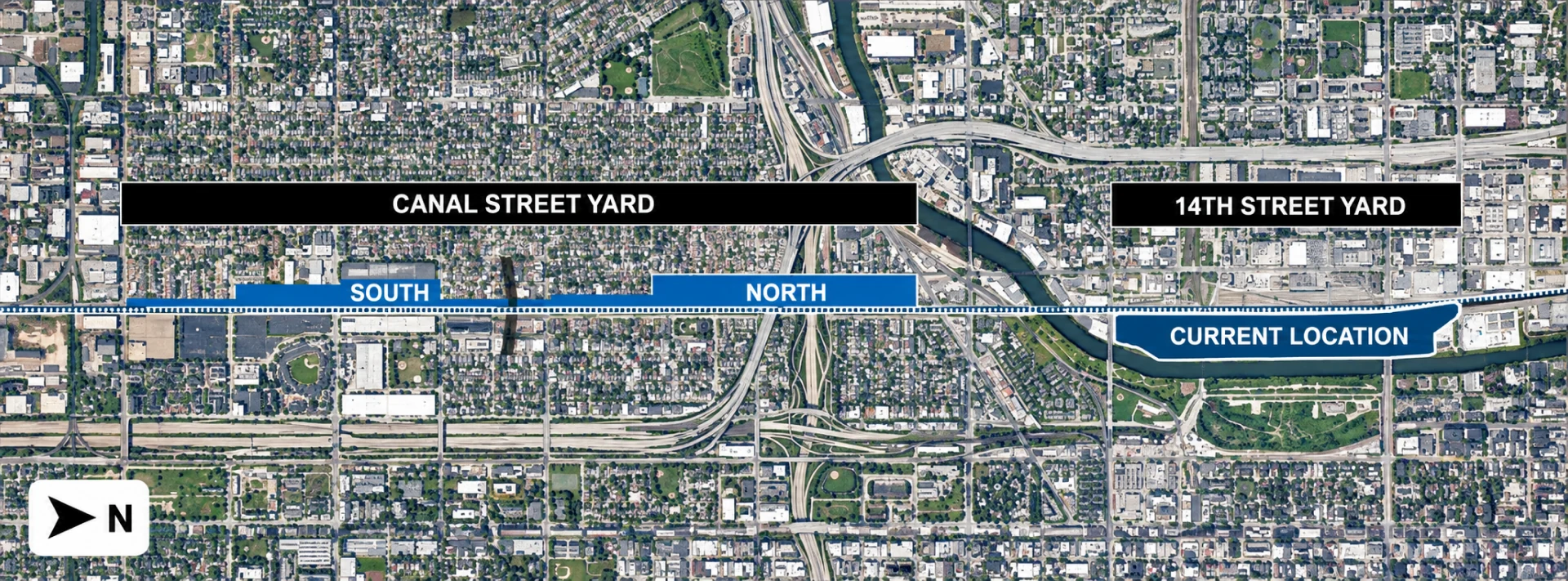
The Canal Street Yard runs roughly two miles north to south. It extends from just north of Cermak Road to West 38th Street, between South Canal Street and South Stewart Avenue.

Aerial map of the Canal Street Yard and 14th Street Yard showing the current location, north and south segments of the maintenance facility site

Project Information

News & Updates

Aug 14, 2026Trains

Amtrak gets funding for new maintenance facility, bridge projects in Chicago area

Chicago Amtrak projects were a significant winner in the announcement of National Railroad Partnership Program grants, including funding for a new maintenance facility and two awards for bridge and viaduct work.

Read more

Aug 14, 2026Chicago Sun-Times

Amtrak’s funding boost paves way for White Sox chairman-in-waiting Justin Ishbia’s South Loop vision

More than $600 million in federal grants will help Amtrak relocate its Chicago maintenance facility from the South Loop to Bridgeport, paving the way for a new mega development.

Read more

Aug 14, 2026Daily Herald

Influx of funding means new Amtrak trains, updates for aged rail bridges, repair shops in region

Despite outdated infrastructure, an aging fleet, and related cancellations, Amtrak is growing in popularity with Chicagoans and suburbanites.

Read more

Aug 14, 2026Sox Machine

Following up: First domino in Justin Ishbia’s South Loop plan tips

Amtrak announced it has been awarded two grants from the Federal Railroad Administration to fund construction of a new maintenance facility along Canal Street in Bridgeport.

Read more

Aug 15, 2026The Real Deal

Feds’ $696M railway grant opens up Justin Ishbia’s South Loop megadevelopment plan

Private equity billionaire Justin Ishbia’s land assembly strategy in Chicago’s South Loop that could open up a new MLB stadium site for the White Sox took a major step forward.

Read more

Aug 17, 2026World Construction Network

Amtrak wins $659m FRA grant for new maintenance facility, viaduct repairs

Amtrak has received federal grants totaling up to $659m to construct a new maintenance facility and carry out bridge and viaduct repairs in Chicago.

Read more

Aug 17, 2026Railway Age

Amtrak Receives Up to $659MM for Chicago Maintenance Facility, Viaduct Repairs

Amtrak has received up to $659 million in FRA grants for a new Midwest Maintenance Facility in Chicago and repairs to bridges, viaducts, and related structures.

Read more

Aug 17, 2026Chicago Construction News

Federal grants support new Amtrak maintenance facility, rail infrastructure upgrades in Chicago

FRA has awarded Amtrak up to $659 million in grants for a new Midwest Maintenance Facility and repairs to bridges and viaducts in Chicago, with construction expected to begin in fall 2026.

Read more

Aug 18, 2026Railway-News

Amtrak Awarded Nearly $3 Billion for New Trains and Rail Infrastructure

Amtrak has been awarded nearly $3 billion in US DOT grants for projects covering fleet renewal, maintenance facilities, bridges, and rail infrastructure.

Read more

Aug 20, 2026Chicago Tribune (Editorial)

Transportation Secretary Sean P. Duffy puts his federal money in the right place

An editorial commenting on the federal funding decision and its Midwest rail implications.

Read more

Aug 20, 2026Chicago Star

South Loop redevelopment plans receive a major boost with $696M federal grant to Amtrak

A $696 million federal investment in Chicago’s Amtrak infrastructure could become a catalyst for a closely watched redevelopment effort.

Read more

Sep 9, 2026Chicago Tribune (Editorial)

Northwestern’s Ryan Field, Amtrak, Emanuel, Quantum, O’Hare Flyer all beset by objectors

An editorial noting that neighborhood objectors are pushing back on several Chicago-area projects, including this one.

Read more

Sep 11, 2026High Speed Rail Alliance

Progress Towards a New Amtrak Maintenance Yard in Chicago

Amtrak is purchasing Union Pacific’s Canal Street yard to build a modern maintenance facility with climate-controlled indoor tracks, replacing the outdated 14th Street Coach Yard.

Read more

Project Collaborators

Our Team

Owner

Owns and operates the completed maintenance facility.

Construction Manager

Construction management joint venture.

Engineering

Engineering and design services across the yard and viaducts.

Consultant

NEPA consultant.

Developer

Develops and delivers the facility for Amtrak.

Opportunities

Subcontractor /
Vendor
Opportunities

Subcontractor, supplier, and vendor prequalification
01 Professional Services 2 scopes
  • Survey & Layout
  • Vibration Monitoring
02 Site and Yard Construction 21 scopes
  • Site & Structure Demolition
  • Earth Retention
  • Fencing
  • Site Clearing
  • Deep Foundations
  • Erosion Control
  • Earthwork
  • Trackwork
  • Site Signage
  • Trucking
  • Concrete Supply
  • Site Electrical, Lighting, & Communications
  • Aggregate Supply
  • Reinforcing Steel
  • Train Communications & Signaling
  • Site Utilities
  • Site Concrete
  • Asphalt & Paving
  • Fueling Systems
  • Process Utilities
  • Maintenance of Traffic
03 Facility Construction 29 scopes
  • Precast Structural Concrete
  • Metal Fabrications
  • Fireproofing
  • Precast Architectural Concrete
  • Carpentry
  • Sprayed Foam Insulation
  • CIP Concrete
  • Millwork & Casework
  • Caulking & Sealants
  • Reinforcing Steel
  • Metal Panel Systems
  • Doors, Frames, Hardware
  • Masonry
  • Roofing
  • Overhead Doors
  • Structural Steel
  • Waterproofing
  • Glass & Glazing
  • Finishes
  • Lockers
  • Fall Protection Systems
  • Painting/Sealers
  • Elevators
  • Mechanical, Electrical, Plumbing, Fire Protection
  • Signage
  • Overhead Crane Systems
  • Process Piping
  • Lube Systems
  • Train Vehicle Maintenance Equipment
04 Viaduct Rehabilitation 10 scopes
  • Selective Bridge Demolition
  • CIP Concrete
  • Lighting
  • Lead Abatement
  • Reinforcing Steel
  • Maintenance of Traffic
  • Steel Fabrication & Supply
  • Concrete Repair
  • Structural Steel
  • Deck Waterproofing